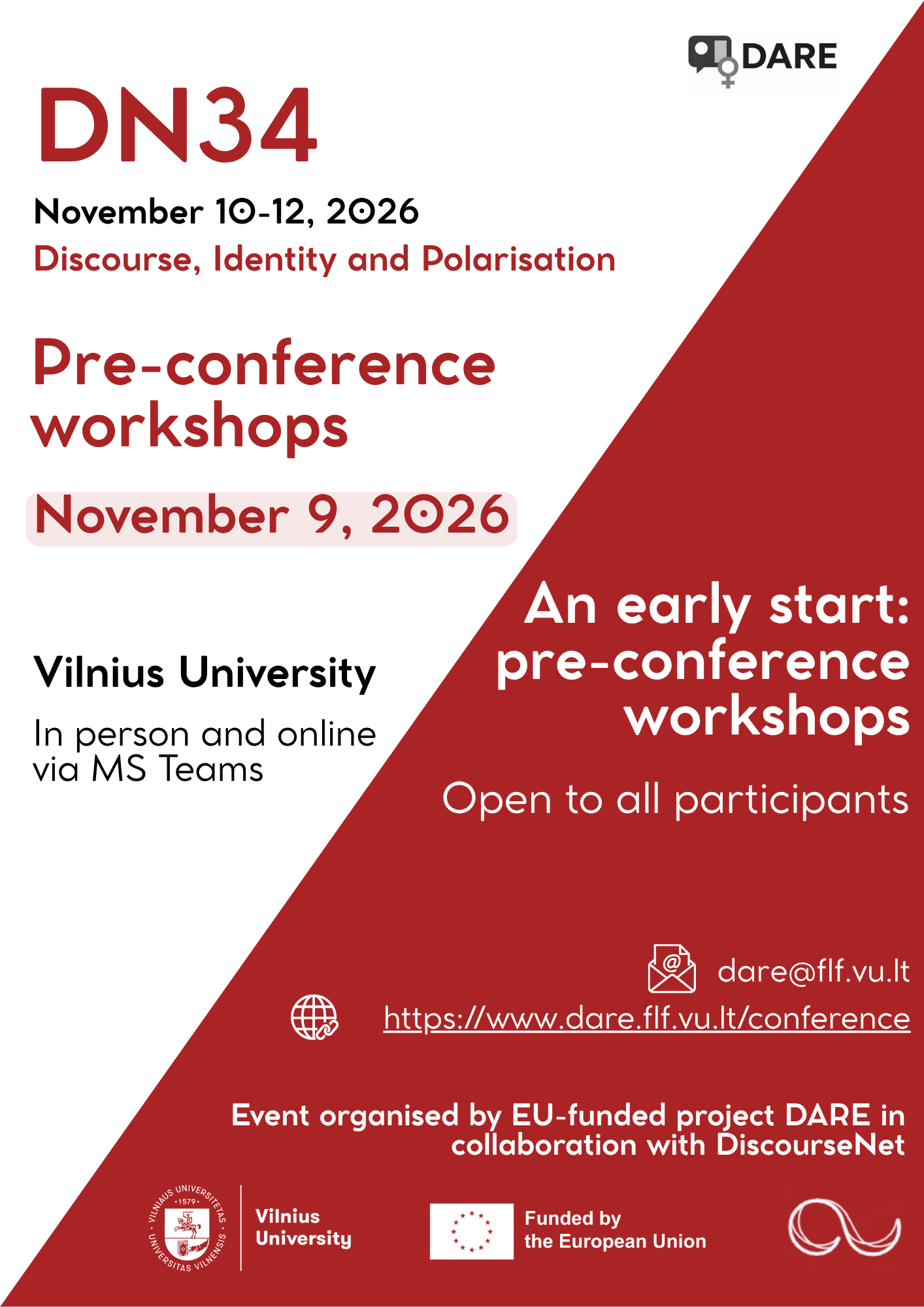
We are pleased to announce that the DN34 conference on Discourse, Identity and Polarisation will feature two pre-conference workshops on 9 November, the day before the main conference programme (10–12 November). These workshops are designed especially for doctoral candidates, postdoctoral researchers, and other early-career scholars, offering practical guidance and opportunities for discussion on key aspects of academic research, career development and interdisciplinarity in discourse studies. At the same time, participants at all career stages — from undergraduate students to senior researchers — are warmly welcome to attend.
The workshops aim to provide participants with tools and insights that complement the academic programme of the conference, while also creating a space for exchange and networking (and warming up for the conference!).
You may find the complete information about the workshops below.
Applying for MSCA and ERC Starting Grants: Strategies, Evaluation Criteria, and the Discursive Construction of “Excellence” in European Research Funding. 10:00 - 11:30h, Nov 9. V. Krėvės Auditorium.
Eleonora Esposito
Institute for Culture and Society
University of Navarra
European research funding programmes such as the Marie Skłodowska-Curie Actions (MSCA) and the ERC Starting Grant represent two of the most important opportunities for early-career researchers in Europe. Yet navigating these schemes can be challenging, particularly for doctoral candidates and postdoctoral researchers who are approaching European funding for the first time.
This session provides a practical introduction to how researchers can successfully prepare competitive applications for MSCA fellowships and ERC Starting Grants. It will explain the objectives, structure, and evaluation criteria of the two programmes, highlighting key differences in terms of career stage, expectations of scientific leadership, mobility requirements, and proposal design.
Alongside this practical guidance, the lecture will also reflect on the broader research policy context in which these programmes operate. In particular, it will examine how concepts such as “excellence”, “impact”, and “frontier research” are articulated in European funding frameworks and how applicants learn to position their work within these narratives. From this perspective, writing a successful proposal is not only a technical exercise but also a process of discursively framing one’s research agenda and academic trajectory within the discursive expectations of European research funding.
The session will combine practical advice on proposal preparation with reflections on academic career development in the European research landscape. It will be particularly relevant for postgraduate students, postdoctoral researchers, and early-career scholars interested in applying for European funding schemes.
The talk will include time for questions and discussion.
Reading across disciplines: CDA and literary critique in polarisation and identity research. 12:00 - 13:30h, Nov 9. V. Krėvės Auditorium.
Orlagh Woods & Silvia Peterssen
Vilnius University
This workshop aims to show how feminist literary analysis and feminist critical discourse studies can intertwine to study polarisation and identity, using the Polish context as a case study. In 1993, Poland introduced one of Europe’s strictest abortion laws, allowing abortion only in cases of rape/incest, foetal abnormality or danger to maternal life. In 2021, the Constitutional Tribunal ruling effectively banned abortions for foetal abnormalities, triggering nationwide protests. This backlash against women’s reproductive rights can be linked not only to the rise and normalisation of radical right populisms and their antifeminist agendas (represented by PiS, the Law and Justice party, in Poland), but also to the central role of Catholic religion in the country.
Despite the rise of antifeminist discourses and policies, the Polish female writer and feminist activist Olga Tokarczuk was awarded the Nobel prize in 2018. Since then, Tokarczuk has gained prominence in Poland and worldwide, and she has not only publicly expressed support for progressive causes, including reproductive rights and climate change activism, but also explicitly condemned populism, capitalism and the far right. She considers her literary work and storytelling as her main platform for activism. However, Tokarczuk also remains a controversial figure, as she has been recently criticised for her statements on the use of AI in the literary creative process.
Considering the polarisation surrounding Tokarczuk and the Polish context, our study analyses two different dimensions of this female writer: (i) media representations of Tokarczuk, and (ii) excerpts of her work as potential manifestations of her feminist and anticapitalist views.
The main goal of this workshop is, however, not to provide an in-depth analysis of this corpus, but rather to take the audience into the interdisciplinary collaborative process between a literary scholar and a discourse scholar, explaining how we would approach this research, the convergence and divergence between our frameworks, and finally practicing the application of our joint approach in short excerpts.
The talk will include time for questions and discussion.